To be released April 7, 2017 by The Wild Rose Press!
On the verge of her long-sought career breakthrough, singer Isbel Vargas has just completed the performance of a lifetime when a kidnapper demands a ransom for her father. Thanks to his car theft and antiquities operation, her father will be arrested if she involves the Acapulco police. Who can she turn to?
Isbel's ex-boyfriend, Cane Mullins, is once again south of the border, purportedly tracking down his beloved Camaro, a vintage street rod stolen years before by her father. Cane gets more than he bargains for, though, when he again crosses paths with the exquisite singer. Chased at high speed through the Sierra Madres, the former lovers search for Isbel's father and a priceless sword he has hidden away, the sole surviving Aztec maquahuitl, while sparks fly and passion reignites. But can Isbel trust Cane again...with her heart?
The Wild Rose Press link
Amazon link
Barnes & Noble link
Showing posts with label Janet Fogg. Show all posts
Wednesday, March 29, 2017
Sunday, March 26, 2017
Where's Annie?
Thank you, Bookworm for Kids! "With edge-of-the-seat adventure, this gunslinger heroine takes on all sorts of dangerous villains and shows the world just what one girl can do."
"I strapped on some chaps and spurs and sat down with the authors. They graciously answered a few questions." ~ Greg Pattridge of Always in the Middle.
Wednesday, November 12, 2014
It Takes Courage to be a Writer
I glory in tales of heroes and heroines, those who risk everything to gain or protect their passion, whether it’s love, conquering new planets, or righting a wrong. These stories resonate in my heart – I pray they always will.
In The Green Hills of Earth, a short story by Robert A. Heinlein, “Noisy” Rhysling, a blind and dying balladeer is catching rides back to Earth where he wants to be laid to rest. Yet he sacrifices himself to repair a malfunctioning space ship. His final song, before he dies…
…harsh bright soil of Luna -
Out ride the sons of Terra,
Far drives the thundering jet -
Saturn's rainbow rings -
the frozen night of Titan -
We pray for one last landing
On the globe that gave us birth
Let us rest our eyes on the fleecy skies
And the cool, green hills of Earth.
Then there are Batty’s final words in Blade Runner:
“I've seen things you people wouldn't believe. Attack ships on fire off the shoulder of Orion. I've watched C-beams glitter in the dark near the Tannhauser Gate. All those moments will be lost in time, like tears in rain.”
Yes, Batty is the “bad guy,” but at that moment he’s captured his life as neatly as the pair of doves he holds in his hands. And he is transformed, as is Dekker, the “good guy.” Both want to experience “things you people wouldn’t believe.”
It takes courage to set emotions to paper and perseverance to claim the tale. It takes courage to be a writer. We might not wear armor and carry swords, but then again, I have traveled through space, danced on moons, and won the battle of battles. I’ve traveled back in time and flown P-51s. I've risked my life to save others, and I’ll do it all again tomorrow. I hope you will, too.
Janet Fogg
www.janetfogg.com
In The Green Hills of Earth, a short story by Robert A. Heinlein, “Noisy” Rhysling, a blind and dying balladeer is catching rides back to Earth where he wants to be laid to rest. Yet he sacrifices himself to repair a malfunctioning space ship. His final song, before he dies…
…harsh bright soil of Luna -
Out ride the sons of Terra,
Far drives the thundering jet -
Saturn's rainbow rings -
the frozen night of Titan -
We pray for one last landing
On the globe that gave us birth
Let us rest our eyes on the fleecy skies
And the cool, green hills of Earth.
Then there are Batty’s final words in Blade Runner:
“I've seen things you people wouldn't believe. Attack ships on fire off the shoulder of Orion. I've watched C-beams glitter in the dark near the Tannhauser Gate. All those moments will be lost in time, like tears in rain.”
Yes, Batty is the “bad guy,” but at that moment he’s captured his life as neatly as the pair of doves he holds in his hands. And he is transformed, as is Dekker, the “good guy.” Both want to experience “things you people wouldn’t believe.”
It takes courage to set emotions to paper and perseverance to claim the tale. It takes courage to be a writer. We might not wear armor and carry swords, but then again, I have traveled through space, danced on moons, and won the battle of battles. I’ve traveled back in time and flown P-51s. I've risked my life to save others, and I’ll do it all again tomorrow. I hope you will, too.
Janet Fogg
www.janetfogg.com
Tuesday, July 15, 2014
Literary Associate Elizabeth Copps is interviewed!
Today, I have the pleasure of interviewing Elizabeth Copps, Literary Associate with the Maria Carvainis Agency, Inc.
MCA’s clients include Mary Balogh, Sandra Brown, Candace Camp, Cindy Gerard, Kristan Higgins, Will Thomas, and Laura Wright among others.
Thank you for joining us, Elizabeth!
JF: Please tell us about your typical work day (and how many manuscripts you usually have waiting in your inbox).
EC: Our solicited manuscript log is ongoing, so I have a lot to sift through every day. I usually read between 5 and 10 manuscripts a week depending on whether I am reading partial or full projects. Regarding query letters—the agency usually receives between 20 and 25 letters a day. We try our best to respond to every query within 10 business days of receipt.
JF: What gets you excited in a query letter? Do you have any pet peeves when it comes to submissions?
EC: Queries that read similarly to a blurb on the back of a book always make me sit up and take notice. I love tight, witty language. Additionally, I want to be hooked by a story’s concept from the first sentence or two of the pitch—but fascinating and unusual characters appeal to me as equally as an intriguing plot.
As far as pet peeves are concerned, I have three biggies:
1. Failing to research our agency’s submission guidelines. It’s clear to me when authors have not done their due diligence. Query letters that are not personalized, or queries with 30 other agents copied on the same email are giveaways.
2. Providing biographical information before describing the writing project. I’m very interested in hearing about a writer’s credentials or reading a short biography, but a writer’s first job is to sell me on their book.
3. Starting with an excerpt of the novel instead of a formal pitch. I appreciate receiving 10-15 sample pages in a separate attachment so I can get a sense of the writing, but it is disorienting to begin reading a sample without any context.
JF: Certain agents edit a manuscript prior to shopping it to editors. Others don’t. How would you describe your process?
EC: Providing our authors strong editorial feedback is a service we pride ourselves on at MCA. We want the best, most polished version of our client’s work to land on an editor’s desk.
JF: What do you enjoy most about representing authors to the publishing industry? Least?
EC: In publishing, I really do feel like I get to have my cake and eat it too. I have the privilege of working with highly creative minds as well as impressively business-savvy men and women. I love that I’m in a position where the two sides of the industry merge.
The most unenjoyable aspect of the business has to be sending rejection letters. It’s a necessity, but it can be really difficult. Agents receive rejection letters too, so I know that it is never a good feeling to see one pop up in your inbox.
JF: Which social media venues do you consider most important for authors: a website, a blog, Twitter, Facebook, or Goodreads? Are there others you recommend?
EC: Knowing their way around all types of social media platforms can only benefit authors, especially those who are hybrid or self-published writers. I will say that I believe having a strong website is a necessary foundation for any writer. A website should contain links to an author’s Facebook, Twitter, blog etc. as well as the option to sign up for a weekly or monthly newsletter. Play to your strengths. For example, if you know you can keep up a Twitter account, do so. If you know you hate Facebook and will rarely post, you won’t do yourself or your readers any favors by starting up an account.
JF: What one piece of advice would you offer to authors who plan to pitch their novel to you at Colorado Gold?
EC: Have fun with it! Tell me why you’re passionate about the book you wrote. If I can see how enthusiastic you are about the characters and the plot, chances are I’ll be excited to read your work too.
JF: What do you do for fun when you’re not working?
EC: I’m a big foodie, and I should probably make my motto something along the lines of, “no cookie left behind.” I also have a serious travel bug. This year I am lucky enough to be doing quite a bit of domestic travel for business. Louisiana, Texas, Tennessee and of course Colorado are on the docket thus far for 2014.
JF: Now I would like to ask an off-track question. What did you dream of doing when you were twelve years old?
EC: I was convinced that I was going to be a famous painter. The best afterschool class my mom ever enrolled me in was called “Art Safari.” The classroom was in a converted warehouse, and the teacher filled it floor to ceiling with every art supply imaginable. The first day I walked in she looked at me and said, “Create!” It was pretty magical.
Thank you,Elizabeth !
Thank you,
You can visit http://mariacarvainisagency.com/ for submission guidelines, or meet with
Janet Fogg
Wednesday, May 14, 2014
How do I love three? Let me count the ways.
I love three to the depth and breadth and… maybe not that much.But there is a lot of love for three. The Three Stooges. The Three Little Pigs. Musketeers. Kings. Bears. Billy Goats. Wicked Stepsisters. Mice. Three, three, three. I could go on and on.
Let’s start with the Rule of Three. It goes way back. Think about storytelling from Aristotle’s Poetics. A beginning, middle, and end. A progression that creates tension, escalates tension, and then offers a satisfying release. Whew!
Syd Field suggests a three-act structure for screenwriting that’s a simple outline for any storytelling. Setup, confrontation, and resolution punctuated by two plot points or reversals. The first reversal is an event that sends the protagonist on a new pathway. The second is a major event that makes everything look impossible. Works for me.
Giving a speech? Max Atkinson offers examples on the use of three-part phrases, or “claptraps,” to evoke a response in the audience, in his book Our Masters’ Voices. Ah, claptraps, when your speech or story makes an audience applaud.
Tell me a name three times and I’ll likely remember it. Tell me once, maybe not. So if you need to emphasize an idea, tell me three times or use three adjectives.
Then there are all sorts of slogans. “Location, location, location.” “Go, fight, win!” “Veni, vidi, vici.”
Aren’t descriptions more effective in threes? Think of a “three dog night.” On cold nights indigenous Australians would sleep in a hole in the ground embracing a dingo. On colder nights they’d sleep with two dingoes, and if the night was raw and freezing it was a “three dog night.” (Or a 1965 band.) But pause for a moment and picture your hero shivering in that deep, cold hole you’ve dug. You want your readers to shiver with him, exhale frosty breath. What's going to best describe that bone-aching cold? One dingo or three?
Now let me think, how many times does Jack climb the beanstalk? On the count of three, let’s all say it together. One. Two. THREE!
by Janet Fogg
Janet is the author of Soliloquy, an award-winning historical romance, and co-author of Fogg in the Cockpit.
Re-posted from 2012.
Wednesday, January 15, 2014
Stephen King's Great Commandment...
…is “read a lot, write a lot.”
Read a lot? Got that covered. No problem.
Write a lot? Well, in comparison to Stephen King, no. He likes to write ten pages a day, every day, with very few skipped days. His pages are 200 words each, so 2,000 words a day.
Writing 2,000 words a day, even 80% of the time, would be five to eight books a year. NOW you’re talking! Talking the impossible, for me, anyway. Once in a while I manage to write 2,000 words a day, but that’s rare. In fact, I’m pleased if I write 500, though 250 isn’t out of the norm, but 2,000? Day after day? Hah!
What about editing? For me, the Great Commandment needs to include editing because it’s such an integral part of my writing process. I'm a scroller. Each day I scroll back at least a few pages in my manuscript, if not five or six, to read and edit. Then I write new words. Scrolling back immerses me in the story, gets me focused, and reminds me where I left off. Perhaps that’s why I’m not speedy – I spend so much time editing. Periodically I print out fifty or a hundred pages for a “major” read for story continuity, and of course at the end of the first draft it’s edit, edit, edit. So I think I need to adapt the Great Commandment to my own writing style by saying, “read a lot, write a lot, edit a lot.”
What about you?
Janet Fogg
Janet is the author of Soliloquy, an award-winning historical romance, and co-author of Fogg in the Cockpit.
Read a lot? Got that covered. No problem.
Write a lot? Well, in comparison to Stephen King, no. He likes to write ten pages a day, every day, with very few skipped days. His pages are 200 words each, so 2,000 words a day.
Writing 2,000 words a day, even 80% of the time, would be five to eight books a year. NOW you’re talking! Talking the impossible, for me, anyway. Once in a while I manage to write 2,000 words a day, but that’s rare. In fact, I’m pleased if I write 500, though 250 isn’t out of the norm, but 2,000? Day after day? Hah!
What about editing? For me, the Great Commandment needs to include editing because it’s such an integral part of my writing process. I'm a scroller. Each day I scroll back at least a few pages in my manuscript, if not five or six, to read and edit. Then I write new words. Scrolling back immerses me in the story, gets me focused, and reminds me where I left off. Perhaps that’s why I’m not speedy – I spend so much time editing. Periodically I print out fifty or a hundred pages for a “major” read for story continuity, and of course at the end of the first draft it’s edit, edit, edit. So I think I need to adapt the Great Commandment to my own writing style by saying, “read a lot, write a lot, edit a lot.”
What about you?
Janet Fogg
Janet is the author of Soliloquy, an award-winning historical romance, and co-author of Fogg in the Cockpit.
Wednesday, December 11, 2013
From the ETO in 1943: My Most Memorable Christmas
by Sgt. James Underwood, 359th Fighter Group
As an Air Force Sergeant, at a fighter base inEngland during World War II, Christmas 1943 promised only homesickness.
There was to be a party at the NCO club, but no one seemed to be very enthused about the thought of it. Most everyone on the base had thoughts of home, missed families, wives and sweethearts.
My buddy, Sgt. Brown, and I had recently been dating two English girls, sisters, who lived in the smallvillage of Thetford , five miles from the base. We had met their parents and had tea with them on several occasions.
The English outlook that year was also pretty bleak. The war had dragged on for four years. Rationing and lack of man-power at home had taken its physical and mental toll. Our adopted family hadn't even planned to have a Christmas tree.
Brownie and I had been saving our candy ration stamps to buy Lifesavers (the girls favorite) as part of gifts we planned for our dates and their family.
Then on the day before Christmas we decided we'd take them a tree and use the Lifesavers strung on string as decorations. We had found a bale of German "anti-radar" aluminum strips that had been dropped during a raid and still intact. They were a close substitute for tinsel. More decorations.
We'd have to have some music, so off we went to Special Services where we borrowed a record player and a half dozen records. We next visited our mess sergeant, told him of our plans, and he came up with cans of roast beef, a tin of butter, jams, sugar, flour, tea - a small crateful.
We had only bicycles for transportation and that five miles was going to be a long ride.
We went about arranging for an overnight pass for we had been invited to visit theNewtons on Christmas Eve and spend Christmas Day with them.
Sgt. Brown was the projectionist at the base theater and could not get off until 11 p.m. Christmas Eve. My job was to load the bikes and be ready. A record player, a crate of food, a box of "tinsel," gifts, candy and records were all dutifully strapped to the two bikes. They looked like an accident searching for a place to happen!
Fog layered the road as we started out. Our small blackout flashlights did little to cut the damp and drippy darkness. A short way down the road stood some pine trees. We had blazed one the day before so that we could pick it out at night. Luckily we found it. We only wanted the top, and since I am short it was my assignment to climb the tree.
Up and up I went into the inky blackness. Stealthily now, for this was Her Majesty's forest and we had no rights at all being in there. Using a broken hacksaw blade, somehow I got the job done and down came the top of the pine.
Now came the real tricky part. Our bikes had been unwieldy and nearly unmanageable before. Now we had to tote a five-foot Christmas tree. We managed, somehow, to ride through the fog, the drizzle and the dark to our destination.
We knocked on the door, shouting Merry Christmas. As we began to unload the bikes the looks on our friend's faces ran from amazement to glee. And when we brought in the tree, it was joyful bedlam!
In half an hour we had set up and decorated the tree, distributed the gifts and were dancing to Glenn Miller records. A bottle of wine came from somewhere and we toasted the arrival of Christmas, 1943 with happy hearts.
The following spring the English girl and I were married.
---------------------------
As an Air Force Sergeant, at a fighter base in
There was to be a party at the NCO club, but no one seemed to be very enthused about the thought of it. Most everyone on the base had thoughts of home, missed families, wives and sweethearts.
My buddy, Sgt. Brown, and I had recently been dating two English girls, sisters, who lived in the small
The English outlook that year was also pretty bleak. The war had dragged on for four years. Rationing and lack of man-power at home had taken its physical and mental toll. Our adopted family hadn't even planned to have a Christmas tree.
Brownie and I had been saving our candy ration stamps to buy Lifesavers (the girls favorite) as part of gifts we planned for our dates and their family.
Then on the day before Christmas we decided we'd take them a tree and use the Lifesavers strung on string as decorations. We had found a bale of German "anti-radar" aluminum strips that had been dropped during a raid and still intact. They were a close substitute for tinsel. More decorations.
We'd have to have some music, so off we went to Special Services where we borrowed a record player and a half dozen records. We next visited our mess sergeant, told him of our plans, and he came up with cans of roast beef, a tin of butter, jams, sugar, flour, tea - a small crateful.
We had only bicycles for transportation and that five miles was going to be a long ride.
We went about arranging for an overnight pass for we had been invited to visit the
Sgt. Brown was the projectionist at the base theater and could not get off until 11 p.m. Christmas Eve. My job was to load the bikes and be ready. A record player, a crate of food, a box of "tinsel," gifts, candy and records were all dutifully strapped to the two bikes. They looked like an accident searching for a place to happen!
Fog layered the road as we started out. Our small blackout flashlights did little to cut the damp and drippy darkness. A short way down the road stood some pine trees. We had blazed one the day before so that we could pick it out at night. Luckily we found it. We only wanted the top, and since I am short it was my assignment to climb the tree.
Up and up I went into the inky blackness. Stealthily now, for this was Her Majesty's forest and we had no rights at all being in there. Using a broken hacksaw blade, somehow I got the job done and down came the top of the pine.
Now came the real tricky part. Our bikes had been unwieldy and nearly unmanageable before. Now we had to tote a five-foot Christmas tree. We managed, somehow, to ride through the fog, the drizzle and the dark to our destination.
We knocked on the door, shouting Merry Christmas. As we began to unload the bikes the looks on our friend's faces ran from amazement to glee. And when we brought in the tree, it was joyful bedlam!
In half an hour we had set up and decorated the tree, distributed the gifts and were dancing to Glenn Miller records. A bottle of wine came from somewhere and we toasted the arrival of Christmas, 1943 with happy hearts.
The following spring the English girl and I were married.
---------------------------
Sgt. James R. Underwood wed Miss Freda Newton on April 8, 1944. The Underwoods had a daughter before the 359th Fighter Group sailed for the U.S. at war’s end.
"My Most Memorable Christmas" by Sgt. James Underwood, a 1943 story from the 359th Fighter Group's archives, was selected for inclusion in the ebook Heart of Christmas published by Sparkle Press. The story was archived by Char Baldridge, Historian, 359th Fighter Group Association, and submitted to Sparkle Press by Janet Fogg and Char Baldridge. Janet and Char manage the 359th Fighter Group's Facebook page, posting archived stories and photos every day. We hope you'll stop by!
Wednesday, November 13, 2013
Splitwing, a Trail Winds tale
“I call this meeting to order. Order, I say! Wingtip, why must you bob up and down on that cattail? Please! Be still and be silent!” warbled Quickeye as he called the flock of blackbirds to order. A solemn quiet claimed the marsh as Quickeye dipped his head at the slender young bird perched in front of him. “Here now, Singsweet, tell us your tale.”
Singsweet fluttered her wings then tucked them close. Her eyes glistened as she sang, “I left our nest to snatch a bite to eat. Bigtail rested nearby, so he could keep watch. When I returned he was far away, flying very fast. In front of him, but flying faster still, flew something big and brown.” At this news there was a rustling and ruffling of feathers amongst the flock. When the birds settled down Singsweet cried, “Our hatchlings were gone!”
Quickeye raised a wing and covered his head for a moment. When he’d recovered, he straightened and crooned, “You are most brave to sing to us tonight.” Quickeye glanced to his right. “Bigtail, will you now share your tale?”
The large blackbird clasping a nearby branch nodded. He cocked his head to one side, gathering the flock’s attention. “I heard a noise like the wind through high grass, and then our hatchlings fell silent. This...this great brown bird had landed on our nest! It snatched up our little ones and raced away. I flew after, but I was slow. Too slow.” Bigtail gazed sadly at Singsweet and trilled, “I failed you, my dearest. I am so sorry.”
One bird exclaimed, “We must protect our nests!”
“Yes, we must find a way!” another agreed. “More eggs will soon hatch.”
At the rear of the flock perched a slim young bird named Splitwing. He remained silent. Always a quiet bird, Splitwing often flew alone, seeking the wind in his face and the quietest of places in the swamp. No one knew him well, yet he was always made welcome when he perched with the flock.
Quickeye nodded. “Thornbeak, will you organize additional guards for each nest?”
A tough old bird with a narrow pointed beak nodded and fluffed his feathers importantly as a chorus of agreement echoed through the reeds. Thornbeak found himself surrounded, as bird after bird fussed and fretted while suggesting patterns to fly or where to perch while guarding each nest.
The top edge of the sun fell below the horizon and Quickeye whistled once more, a single long note, loud and piercing. He closed the meeting by singing, “Remember to report to Thornbeak again at first light. As for tonight, stay close and guard well. We must protect our young.”
Before the older bird could take flight, Splitwing soared up to Quickeye. “May I sing to you for a moment?” he asked. “Alone?”
Quickeye nodded and flitted into the darkest shadows at the edge of the marsh. He grasped the top of a cattail and turned expectantly to watch Splitwing land below him on the same stem.
Splitwing crooned, “Tomorrow I wish to be excused from guarding the nests. Instead, please allow me to circle high above the entire marsh, to keep watch on us all.”
Quickeye whistled softly in surprise.
As if in apology, Splitwing trilled, spreading his wings and tail feathers. “I am used to flying alone and can fly high, and for a long, long time.”
Quickeye considered this as the breeze pushed against them, making the cattails rock and sway. He flipped his tail up and down to keep his balance and nodded abruptly. “Very well. I will make your excuses to Thornbeak.” He raised one wingtip, waving Splitwing away.
Early the next morn, before even the sun heaved itself into the sky, Splitwing hunted out a quick meal. He then jumped aloft. As the dark of night folded, and the eastern horizon spilled pink into the sky, Splitwing flew upward where he circled, gazing down upon each tree and bush and thick patch of reeds. Again and again he circled. Just as yellow light reached upward to engulf the pink, he hovered, staring intently at the canopy of treetops that shaded the far western edge of the marsh.
Something brown fluttered amongst the leaves! He folded his wings and arrowed down. Yes! Again it moved! He glimpsed broad brown wings and a thick body as the bird ducked beneath branches, seeking always to hide in dark shadows. Whistling the alarm, Splitwing shot through the sky. The intruder twisted its head to glare at Splitwing before dropping from a branch to soar away.
Splitwing raced after.
The intruder stooped and turned on wingtip. Without losing a single beat of his wings, Splitwing swerved in exactly the same spot, but soon he despaired. With each push of his wide wings the large bird pulled away. He would escape!
Splitwing thought of Singsweet and her lost hatchlings. He remembered how kind the flock had been to him, how respectful and welcoming. His resolve firmed; he would not let them down.
Reaching into the depths of his heart, Splitwing managed somehow to beat his wings faster. He gained on the bird. Closer and closer he came. Soon, they were only a few wing lengths apart. But then the northern breeze lifted and Splitwing faltered. No! He was so close! He lifted his head and called upon the wind, trilling long and deep. He raised his wings to their highest point and slapped the air. Over and again. He pushed harder to find even more resolve, more strength, more speed. His wings blurred against the brightening sky as his heart raced. The wind weakened. Again Splitwing reached for more. Close. So close. He could see the fierce black talons of the brown bird, its thick strong legs clad in mottled brown and white. One more wing length. One final push. His wings smote the air and red flames burst from his black feathers.
Hurling himself upon the flock’s enemy, Splitwing curled his talons into the bird’s wide, right wing. Locked together, they tumbled and twisted through the sky, flames dancing from Splitwing's wings onto the intruder’s before engulfing them both. They plummeted through the sky, a fiery ball that first grew large and then shriveled to embers.
Watching from below, the flock trilled and sang and fluttered and cried, their respect for Splitwing floating upward upon the very same north wind which had first challenged then supported him. As ashes drifted across the marsh, every bird fell silent.
That evening the flock gathered to trill, offering soft harmonies to accompany the sun as it settled down from the heights. The gentle blackbirds sang about Splitwing, the quietest of birds. The mothers whispered in sorrow but also wept with joy, for now their young would be safe. The fathers and brothers crooned, first one then the other, each praising Splitwing’s speed, his strength and courage, and his great resolve. Such a sacrifice. Such a flight.
Days flew by and when new eggs hatched there was great rejoicing; the flock would live on. Nearly every nest had hatchlings to feed and every bird sang with happiness.
Drowsing in the sun, Quickeye was startled awake one morning by Softwind, a young mother.
“Quickeye!” she whistled. “Come! You must see my fledglings!”
Quickeye shook himself awake and hurriedly took wing. He landed on the edge of Softwind’s nest. Startled and pleased, Quickeye lifted his wings from his chest, spread his tail feathers, and crooned. He glanced up into the clear blue sky, remembering the final flight of Splitwing, and then looked back into the nest.
“Be not alarmed, Softwind. Don’t you see?” Quickeye trilled as he gazed upon the young birds crowding so close. The two males were as black as they should be, but each bore upon their wings a blinding patch of crimson feathers edged by yellow.
“They bear wings of flame,” Quickeye continued, “just as Splitwing did on his last, great flight. Never shall we forget his gallant heart, for now it shall live with us forever.”
by Janet Fogg
Janet is the author of Trail Winds, Soliloquy, and co-author of Fogg in the Cockpit.
Singsweet fluttered her wings then tucked them close. Her eyes glistened as she sang, “I left our nest to snatch a bite to eat. Bigtail rested nearby, so he could keep watch. When I returned he was far away, flying very fast. In front of him, but flying faster still, flew something big and brown.” At this news there was a rustling and ruffling of feathers amongst the flock. When the birds settled down Singsweet cried, “Our hatchlings were gone!”
Quickeye raised a wing and covered his head for a moment. When he’d recovered, he straightened and crooned, “You are most brave to sing to us tonight.” Quickeye glanced to his right. “Bigtail, will you now share your tale?”
The large blackbird clasping a nearby branch nodded. He cocked his head to one side, gathering the flock’s attention. “I heard a noise like the wind through high grass, and then our hatchlings fell silent. This...this great brown bird had landed on our nest! It snatched up our little ones and raced away. I flew after, but I was slow. Too slow.” Bigtail gazed sadly at Singsweet and trilled, “I failed you, my dearest. I am so sorry.”
One bird exclaimed, “We must protect our nests!”
“Yes, we must find a way!” another agreed. “More eggs will soon hatch.”
At the rear of the flock perched a slim young bird named Splitwing. He remained silent. Always a quiet bird, Splitwing often flew alone, seeking the wind in his face and the quietest of places in the swamp. No one knew him well, yet he was always made welcome when he perched with the flock.
Quickeye nodded. “Thornbeak, will you organize additional guards for each nest?”
A tough old bird with a narrow pointed beak nodded and fluffed his feathers importantly as a chorus of agreement echoed through the reeds. Thornbeak found himself surrounded, as bird after bird fussed and fretted while suggesting patterns to fly or where to perch while guarding each nest.
The top edge of the sun fell below the horizon and Quickeye whistled once more, a single long note, loud and piercing. He closed the meeting by singing, “Remember to report to Thornbeak again at first light. As for tonight, stay close and guard well. We must protect our young.”
Before the older bird could take flight, Splitwing soared up to Quickeye. “May I sing to you for a moment?” he asked. “Alone?”
Quickeye nodded and flitted into the darkest shadows at the edge of the marsh. He grasped the top of a cattail and turned expectantly to watch Splitwing land below him on the same stem.
Splitwing crooned, “Tomorrow I wish to be excused from guarding the nests. Instead, please allow me to circle high above the entire marsh, to keep watch on us all.”
Quickeye whistled softly in surprise.
As if in apology, Splitwing trilled, spreading his wings and tail feathers. “I am used to flying alone and can fly high, and for a long, long time.”
Quickeye considered this as the breeze pushed against them, making the cattails rock and sway. He flipped his tail up and down to keep his balance and nodded abruptly. “Very well. I will make your excuses to Thornbeak.” He raised one wingtip, waving Splitwing away.
Early the next morn, before even the sun heaved itself into the sky, Splitwing hunted out a quick meal. He then jumped aloft. As the dark of night folded, and the eastern horizon spilled pink into the sky, Splitwing flew upward where he circled, gazing down upon each tree and bush and thick patch of reeds. Again and again he circled. Just as yellow light reached upward to engulf the pink, he hovered, staring intently at the canopy of treetops that shaded the far western edge of the marsh.
Something brown fluttered amongst the leaves! He folded his wings and arrowed down. Yes! Again it moved! He glimpsed broad brown wings and a thick body as the bird ducked beneath branches, seeking always to hide in dark shadows. Whistling the alarm, Splitwing shot through the sky. The intruder twisted its head to glare at Splitwing before dropping from a branch to soar away.
Splitwing raced after.
The intruder stooped and turned on wingtip. Without losing a single beat of his wings, Splitwing swerved in exactly the same spot, but soon he despaired. With each push of his wide wings the large bird pulled away. He would escape!
Splitwing thought of Singsweet and her lost hatchlings. He remembered how kind the flock had been to him, how respectful and welcoming. His resolve firmed; he would not let them down.
Reaching into the depths of his heart, Splitwing managed somehow to beat his wings faster. He gained on the bird. Closer and closer he came. Soon, they were only a few wing lengths apart. But then the northern breeze lifted and Splitwing faltered. No! He was so close! He lifted his head and called upon the wind, trilling long and deep. He raised his wings to their highest point and slapped the air. Over and again. He pushed harder to find even more resolve, more strength, more speed. His wings blurred against the brightening sky as his heart raced. The wind weakened. Again Splitwing reached for more. Close. So close. He could see the fierce black talons of the brown bird, its thick strong legs clad in mottled brown and white. One more wing length. One final push. His wings smote the air and red flames burst from his black feathers.
Hurling himself upon the flock’s enemy, Splitwing curled his talons into the bird’s wide, right wing. Locked together, they tumbled and twisted through the sky, flames dancing from Splitwing's wings onto the intruder’s before engulfing them both. They plummeted through the sky, a fiery ball that first grew large and then shriveled to embers.
Watching from below, the flock trilled and sang and fluttered and cried, their respect for Splitwing floating upward upon the very same north wind which had first challenged then supported him. As ashes drifted across the marsh, every bird fell silent.
That evening the flock gathered to trill, offering soft harmonies to accompany the sun as it settled down from the heights. The gentle blackbirds sang about Splitwing, the quietest of birds. The mothers whispered in sorrow but also wept with joy, for now their young would be safe. The fathers and brothers crooned, first one then the other, each praising Splitwing’s speed, his strength and courage, and his great resolve. Such a sacrifice. Such a flight.
Days flew by and when new eggs hatched there was great rejoicing; the flock would live on. Nearly every nest had hatchlings to feed and every bird sang with happiness.
Drowsing in the sun, Quickeye was startled awake one morning by Softwind, a young mother.
“Quickeye!” she whistled. “Come! You must see my fledglings!”
Quickeye shook himself awake and hurriedly took wing. He landed on the edge of Softwind’s nest. Startled and pleased, Quickeye lifted his wings from his chest, spread his tail feathers, and crooned. He glanced up into the clear blue sky, remembering the final flight of Splitwing, and then looked back into the nest.
“Be not alarmed, Softwind. Don’t you see?” Quickeye trilled as he gazed upon the young birds crowding so close. The two males were as black as they should be, but each bore upon their wings a blinding patch of crimson feathers edged by yellow.
“They bear wings of flame,” Quickeye continued, “just as Splitwing did on his last, great flight. Never shall we forget his gallant heart, for now it shall live with us forever.”
by Janet Fogg
Janet is the author of Trail Winds, Soliloquy, and co-author of Fogg in the Cockpit.
From Splitwing, the first Red-winged blackbird, to HeCoYa, a massive gray coyote, in Trail Winds you'll find fanciful tales of how five natural phenomena came to be.
Wednesday, October 9, 2013
Jinxed! (It's not good to be an iynx.)
Shades of Linda Blair!
The origin of the word jinx isn’t clear, but there’s speculation that it might come from iynx, a wryneck bird that’s able to twist its head around 180 degrees while hissing like a snake. Historically, the poor bird has also been used for divination and magic. Steaming entrails, I assume. It’s not good to be an iynx.
As a writer, I often emulate an iynx. My head spins regularly, plus I'm rather good at hissing. Fortunately, my entrails have thus far remained where they belong, though in honor of Halloween we could pause to discuss evisceration in more detail. But I digress...
I sometime wonder whether I’ve jinxed myself by doing or not doing certain things, though I hope I’ll never act like certain baseball players whose actions often amuse and sometimes irritate me. Let’s see, before I touch the keyboard I need to spit, adjust my right sleeve, wipe my forehead, tug on the brim of my baseball cap, wipe my forehead again, tug the brim one more time, then inhale and exhale slowly. Whew! Now it's safe to start writing! Right? Maybe not.
But I do have a few superstitions. (Don’t worry, no steaming entrails.) One of my superstitions is that if I'm in query mode, I want to have at least eight queries out. For me, eight is luckier than three or seven. Does that make me feel as if I'm in control? Yes. Isn’t that good, especially when there's so much we can't control in this crazy business?
How about you? Do superstitions influence your writing day?
by Janet Fogg
Janet is the author of Soliloquy, an award-winning historical romance, Trail Winds, five etiological tales, and co-author of the military history best seller, Fogg in the Cockpit.
The origin of the word jinx isn’t clear, but there’s speculation that it might come from iynx, a wryneck bird that’s able to twist its head around 180 degrees while hissing like a snake. Historically, the poor bird has also been used for divination and magic. Steaming entrails, I assume. It’s not good to be an iynx.
As a writer, I often emulate an iynx. My head spins regularly, plus I'm rather good at hissing. Fortunately, my entrails have thus far remained where they belong, though in honor of Halloween we could pause to discuss evisceration in more detail. But I digress...
I sometime wonder whether I’ve jinxed myself by doing or not doing certain things, though I hope I’ll never act like certain baseball players whose actions often amuse and sometimes irritate me. Let’s see, before I touch the keyboard I need to spit, adjust my right sleeve, wipe my forehead, tug on the brim of my baseball cap, wipe my forehead again, tug the brim one more time, then inhale and exhale slowly. Whew! Now it's safe to start writing! Right? Maybe not.
But I do have a few superstitions. (Don’t worry, no steaming entrails.) One of my superstitions is that if I'm in query mode, I want to have at least eight queries out. For me, eight is luckier than three or seven. Does that make me feel as if I'm in control? Yes. Isn’t that good, especially when there's so much we can't control in this crazy business?
How about you? Do superstitions influence your writing day?
by Janet Fogg
Janet is the author of Soliloquy, an award-winning historical romance, Trail Winds, five etiological tales, and co-author of the military history best seller, Fogg in the Cockpit.
Wednesday, September 11, 2013
Teaching my way through the Baltic - Part 4, by Karen Albright Lin
In March, Karen Albright Lin shared the beginning of her journey on how to teach writing on a cruise. If you didn't have the opportunity to read that blog, here's the link: Writers, Want a Free Cruise? The Secret is Revealed.
In August, Karen shared with us the first two installment on the results of her first trip:
Teaching my way through the Baltic - Part 1
Teaching my way through the Baltic - Part 2
And just yesterday, she shared Part 3 with us.
Today, we're visiting the Baltic for the fourth installment!
To refresh your memory, Karen Albright Lin consults and edits for published and yet-to-be published writers of fiction, nonfiction, and book proposals. She writes in a number of genres and conducts writing workshops in various venues. Her website is www.karenalbrightlin.com.
And now, let's all set sail, and again join Karen in the Baltic!
Janet Fogg
---------------------------------------------------
I kept a journal as I visited ports, befriended people of various nationalities, and taught writing courses on sea days. My trip informed my writing. I learned a lot about people from the Baltic, an area of the world I’d never explored. True of all my trips abroad, travel exposed me to the authentic cuisines of other countries, important since I’m a food writer among other genres.
I conquered preconceived notions while conversing with post cold war Russians and two beer-drinking, twice-our-size brothers from Amsterdam: I wiped out a few stereotypes like discovering that few Scandinavians are tall, blonde, and model beautiful--at least in the cities we visited.
I learned that people on the other side of the pond are even more politically frustrated than we are. The Brits and Danes resent high taxes, welfare run-amok, national health care, and immigration of Muslims who don’t assimilate. The Scotts resent the Brit’s control over them “for the oil” and their disparity of wealth. Every country represented on ship and shore was crushed by inflation (9 dollars for a gallon of gas).
Unusual characters in life might just inspire protagonists and antagonists on the page. We found super quirky in Copenhagen. Danes have a sense of humor. Or at least Christian the IV did. He covered his insecurity and paranoia with hodgepodge décor, a slapped-together art collection, pompous attempts to wow his visitors, and a penchant for practical jokes. Though St. Petersburg’s Church of Spilled Blood had the most remarkable building exterior of the trip. The Rosenborg Castle had the most memorable interior. Built between 1606 and 1617 it contains peep holes in the bedroom doors, as if enemies could somehow make it past guards. He added secret tiles in the floors that allowed music to mysteriously drift up from the orchestra the king relegated to the basement, all to wow his guests. He had deceptive tapestries woven to depict himself triumphant on horseback, leading Denmark as it won battles against their neighbors; we were assured by the museum docents that they won some sea battles but never the land battles and ultimately they lost.
Envying other royals the king had minions travel about purchasing random art. They trimmed them down to fit panels in his home, creating a mosaic of unidentified works on his ceilings and walls proving him to be a snob with bad taste. He claimed his ivory throne was really made of unicorn horn. An ornate tile restroom reminded us of the wanting hygiene of the day; a hole in a wooden bench led right out to the Castle’s moat. If the King’s bad taste didn’t drive them away the stinky moat surely would have. The four corners of a long hall had different corners of the world represented. Europe with an owl, Asia with a camel, Africa with a lion, and the Americas with a head with an arrow shot through it.
The highlight of tacky was the king’s “wet pants chair.” He asked a guest to sit in a red velvet chair, anchored him in at the arms then poured water down a custom cut hole in the back. It dripped down and wet the pants of his victim. Then to add insult to injury, when the hapless visitor stood, the chair made a farting sound, a velvet whoopee cushion. This king was a piece of work, and if the portrait of him in a long hall was any indication, he was extremely ugly, too. So ugly Wen thought the painting might even be a joke, but I doubted it since his Majesty was insecure and wouldn’t likely allow anybody to depict him in this way without chopping off a head.
As writers we sometimes go on unexpected adventures. Copenhagen was no different for us. We hopped on and climbed to the top of an open-air bus to make our way past the famous Tivoli Garden amusement park (claimed to be the most famous in the world – Disney step aside). After several minutes and the departure of other tourists, Wen noticed we were quite a ways off the map’s route. Fun sidetrack? Not really since we were going to be late for the departure of the ship if the route wasn’t as advertised. I climbed down and heard the gasp of the driver as I approached with a map and asked where we were. He didn’t realize anybody was still up top and was almost to the bus depot! So he headed to the port, huffing resentment that his day was going to be thrust back on its usual schedule; he wouldn’t get to quit for the day an hour early.
We got off before the usual port stop a short walk from the ship to see the Little Mermaid who inspired the Disney movie but had a more European fate, having lost her land-locked love after giving up her tail for him. A forlorn wisp of a girl, she was smaller than I had imagined her.
Many things in Copenhagen weren’t as I’d imagined them. I like that about travels. I like that about writing fiction. What was the most unexpected thing you ever saw or did while traveling?
~ Karen Albright Lin
http://karenalbrightlin.com/
In August, Karen shared with us the first two installment on the results of her first trip:
Teaching my way through the Baltic - Part 1
Teaching my way through the Baltic - Part 2
And just yesterday, she shared Part 3 with us.
Today, we're visiting the Baltic for the fourth installment!
To refresh your memory, Karen Albright Lin consults and edits for published and yet-to-be published writers of fiction, nonfiction, and book proposals. She writes in a number of genres and conducts writing workshops in various venues. Her website is www.karenalbrightlin.com.
And now, let's all set sail, and again join Karen in the Baltic!
Janet Fogg
---------------------------------------------------
| Rosenborg Castle |
I conquered preconceived notions while conversing with post cold war Russians and two beer-drinking, twice-our-size brothers from Amsterdam: I wiped out a few stereotypes like discovering that few Scandinavians are tall, blonde, and model beautiful--at least in the cities we visited.
| Crown Jewels |
| Rosenborg Castle |
| Unicorn Horn Chair |
The highlight of tacky was the king’s “wet pants chair.” He asked a guest to sit in a red velvet chair, anchored him in at the arms then poured water down a custom cut hole in the back. It dripped down and wet the pants of his victim. Then to add insult to injury, when the hapless visitor stood, the chair made a farting sound, a velvet whoopee cushion. This king was a piece of work, and if the portrait of him in a long hall was any indication, he was extremely ugly, too. So ugly Wen thought the painting might even be a joke, but I doubted it since his Majesty was insecure and wouldn’t likely allow anybody to depict him in this way without chopping off a head.
As writers we sometimes go on unexpected adventures. Copenhagen was no different for us. We hopped on and climbed to the top of an open-air bus to make our way past the famous Tivoli Garden amusement park (claimed to be the most famous in the world – Disney step aside). After several minutes and the departure of other tourists, Wen noticed we were quite a ways off the map’s route. Fun sidetrack? Not really since we were going to be late for the departure of the ship if the route wasn’t as advertised. I climbed down and heard the gasp of the driver as I approached with a map and asked where we were. He didn’t realize anybody was still up top and was almost to the bus depot! So he headed to the port, huffing resentment that his day was going to be thrust back on its usual schedule; he wouldn’t get to quit for the day an hour early.
| Little Mermaid |
Many things in Copenhagen weren’t as I’d imagined them. I like that about travels. I like that about writing fiction. What was the most unexpected thing you ever saw or did while traveling?
~ Karen Albright Lin
http://karenalbrightlin.com/
Tuesday, September 10, 2013
Teaching my way through the Baltic - Part 3, by Karen Albright Lin
In March, Karen Albright Lin shared the beginning of her journey on how to teach writing on a cruise. If you didn't have the opportunity to read that blog, here's the link: Writers, Want a Free Cruise? The Secret is Revealed.
In August, Karen shared with us the first two installment on the results of her first trip:
Teaching my way through the Baltic - Part 1
Teaching my way through the Baltic - Part 2
Today, we're visiting the Baltic for the third installment!
To refresh your memory, Karen Albright Lin consults and edits for published and yet-to-be published writers of fiction, nonfiction, and book proposals. She writes in a number of genres and conducts writing workshops in various venues. Her website is www.karenalbrightlin.com.
And now, let's all set sail, and again join Karen in the Baltic!
Janet Fogg
---------------------------------------------------
We’d started in Southhampton, had visited Zeebrugge and its famous beer, Rostock in former E. Germany and its darker beer, Stockholm and its unmemorable beer, Helsinki and its watered-down, poor excuse for beer, and St. Petersberg--where we had no time for beer on our elaborate and expensive excursion. I’d taught “Have a Great Story to Tell” and “Writing Your Life” to the curious and receptive who’d passed up a popular quiz game, mud therapy in the spa, a glass blowing show and the fruit and vegetable carving demo. We were just over halfway through our two-week cruise.
As our capable captain guided us into our next port, beer didn’t come to mind.
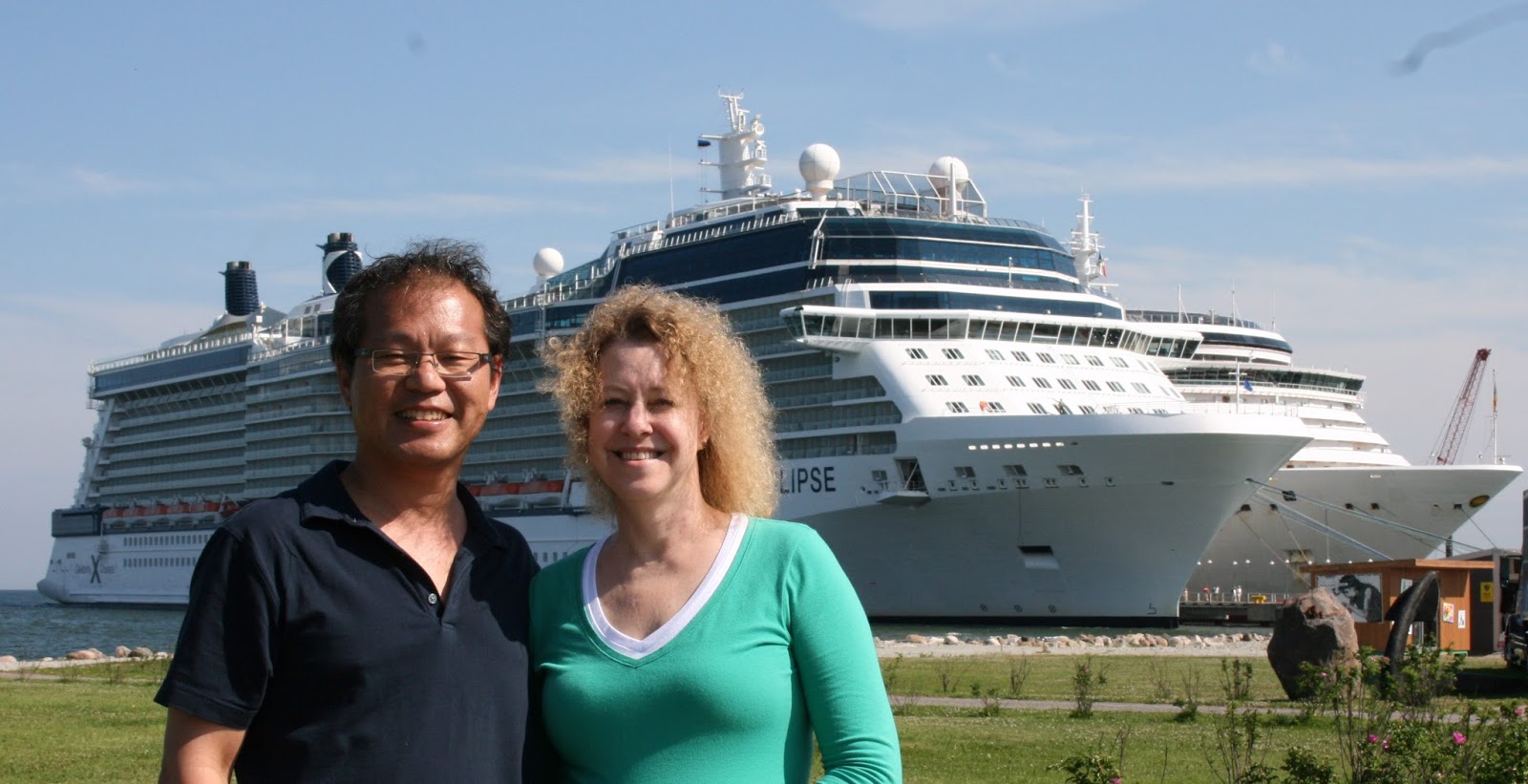
Tallin, Estonia is a delightful sum of many quaint parts: little signs hanging above store fronts, cobblestone roads worth walking on despite the risk of twisting an ankle, ornate lamps, earth-toned vertical homes, arched doorways, turrets, and crosses cutting the sky, cute balconies, archery practice for a price, monuments to successful struggles against neighboring countries, sidewalk cafes and an unexpected gem, The Beer House.
After roaming the town between sun showers, we slid into an outdoor bench where locals enjoyed elaborate salads and beers. We ordered two different varieties from the huge beer-shaped menu. 16 oz each.
Wen ordered a silky light Tallin beer; for me it was a local honey beer. Our delicious first sips were distracted when two 300+ pound brothers who might have been twins tried to pry and struggle their way into the bench seat next door. Perhaps spotting our glances, they decided to come and scootch in next to us. They ordered beers that had to be 1 ½ liters. I thought, “This ought to be interesting.” And it certainly was! These two brothers were amusing, and our hour or so with them was one of the most memorable of the trip.
They were frequent travelers to Estonia from Amsterdam and had raunchy tales to tell of their homeland that went beyond medicinal greens and red-light districts. They shared a unique scoop on Estonia and Holland.
Our dinky beers paled in comparison to theirs so we slid our tiny diminutive butts close to them, took up their mugs (larger than my head) and snapped photos for fun. Since the pictures were on Wen’s smart phone, he immediately emailed them to our new giant friends.
We learned a few lessons: don’t judge a dinner neighbor, open up to even the most unusual fellow travelers, and be sure to tell others about the joy of Tallin’s honey beer, a nice finish to a beautiful day in Estonia! The best of our trip!
~ Karen Albright Lin
In August, Karen shared with us the first two installment on the results of her first trip:
Teaching my way through the Baltic - Part 1
Teaching my way through the Baltic - Part 2
Today, we're visiting the Baltic for the third installment!
To refresh your memory, Karen Albright Lin consults and edits for published and yet-to-be published writers of fiction, nonfiction, and book proposals. She writes in a number of genres and conducts writing workshops in various venues. Her website is www.karenalbrightlin.com.
And now, let's all set sail, and again join Karen in the Baltic!
Janet Fogg
---------------------------------------------------
We’d started in Southhampton, had visited Zeebrugge and its famous beer, Rostock in former E. Germany and its darker beer, Stockholm and its unmemorable beer, Helsinki and its watered-down, poor excuse for beer, and St. Petersberg--where we had no time for beer on our elaborate and expensive excursion. I’d taught “Have a Great Story to Tell” and “Writing Your Life” to the curious and receptive who’d passed up a popular quiz game, mud therapy in the spa, a glass blowing show and the fruit and vegetable carving demo. We were just over halfway through our two-week cruise.
As our capable captain guided us into our next port, beer didn’t come to mind.
Tallin, Estonia is a delightful sum of many quaint parts: little signs hanging above store fronts, cobblestone roads worth walking on despite the risk of twisting an ankle, ornate lamps, earth-toned vertical homes, arched doorways, turrets, and crosses cutting the sky, cute balconies, archery practice for a price, monuments to successful struggles against neighboring countries, sidewalk cafes and an unexpected gem, The Beer House.
After roaming the town between sun showers, we slid into an outdoor bench where locals enjoyed elaborate salads and beers. We ordered two different varieties from the huge beer-shaped menu. 16 oz each.
Wen ordered a silky light Tallin beer; for me it was a local honey beer. Our delicious first sips were distracted when two 300+ pound brothers who might have been twins tried to pry and struggle their way into the bench seat next door. Perhaps spotting our glances, they decided to come and scootch in next to us. They ordered beers that had to be 1 ½ liters. I thought, “This ought to be interesting.” And it certainly was! These two brothers were amusing, and our hour or so with them was one of the most memorable of the trip.
They were frequent travelers to Estonia from Amsterdam and had raunchy tales to tell of their homeland that went beyond medicinal greens and red-light districts. They shared a unique scoop on Estonia and Holland.
Our dinky beers paled in comparison to theirs so we slid our tiny diminutive butts close to them, took up their mugs (larger than my head) and snapped photos for fun. Since the pictures were on Wen’s smart phone, he immediately emailed them to our new giant friends.
We learned a few lessons: don’t judge a dinner neighbor, open up to even the most unusual fellow travelers, and be sure to tell others about the joy of Tallin’s honey beer, a nice finish to a beautiful day in Estonia! The best of our trip!
~ Karen Albright Lin
Wednesday, August 14, 2013
Let's do launch! TRAIL WINDS by Janet Fogg is now available!
Hey! Where's the champagne? On the counter next to the glasses? Okay then, let's pop the cork and launch Trail Winds, five etiological tales presented in this (very short) ebook.
From Splitwing, the first Red-winged blackbird, to HeCoYa, a massive gray coyote, in Trail Winds you'll find fanciful tales of how five natural phenomena came to be.
A recent 5 star review stated: "Heroic metaphors told in the language of conversant animals, reminding adults of how truly clear was the world when we were young. Suggest you share outloud with children at the campfire... just to hear them in the right air." ~ J. J. Wilson
If you enjoy book trailers...
Thanks for stopping by!
~ Janet Fogg
From Splitwing, the first Red-winged blackbird, to HeCoYa, a massive gray coyote, in Trail Winds you'll find fanciful tales of how five natural phenomena came to be.
A recent 5 star review stated: "Heroic metaphors told in the language of conversant animals, reminding adults of how truly clear was the world when we were young. Suggest you share outloud with children at the campfire... just to hear them in the right air." ~ J. J. Wilson
If you enjoy book trailers...
Trail Winds is available from numerous online ebooksellers, including Amazon, Apple, Barnes & Noble, Kobo, Sony, Smashwords, and others!
I hope you enjoy Trail Winds.
~ Janet Fogg
Janet is the author of Soliloquy, an award-winning historical romance, and co-author of the military history best seller, Fogg in the Cockpit.
Tuesday, August 13, 2013
Teaching my way through the Baltic - Part 2, by Karen Albright Lin
In March, Karen Albright Lin shared the beginning of her journey on how to teach writing on a cruise. If you didn't have the opportunity to read that blog, here's the link: Writers, Want a Free Cruise? The Secret is Revealed.
Yesterday, Karen shared the first installment on the results of her first trip. Today, we're visiting the Baltic again for the second installment.
In September we'll share subsequent installments!
To refresh your memory, Karen Albright Lin consults and edits for published and yet-to-be published writers of fiction, nonfiction, and book proposals. She writes in a number of genres and conducts writing workshops in various venues. Her website is www.karenalbrightlin.com.
And now, let's all set sail, and again join Karen in the Baltic!
Janet Fogg
---------------------------------------------------
I never would have thought I’d end up cruising through the Baltic, let alone have it be free for my husband and me. This post is part two of my report on the experience.
We’d visited London for a few days before hopping on the ship, meandered through Belgium for the beer and Rostock in former East Germany. I’d already taught “Have a Great Story to Tell?” and “Writing Your Life” to eager cruise guests. My husband and I had taken up daily Zumba, become regulars on the ballroom and pop dance floors, and had gotten used to the norovirus-restrictive dining. It was DAY SIX, time to visit Stockholm.
We saw cathedrals that all became a blur, a palace, and the building where the Nobel Prizes are awarded. Then we lucked into a prized spot to watch the changing of the guards.

We’d barely caught our breath when we woke too early on DAY EIGHT and DAY NINE to join a large group on our VERY EXPENSIVE 2-day excursion to Russia’s St. Petersburg. If you arrange for a visa yourself ahead of time it is $300. If you take a $370 excursion it is tucked inside that cost. So double that and you can see that it was the biggest cost of our trip – since frequent flyer miles got us to and from the ship in Southampton. It was worth every penny.
Though our guide was painfully political, bashing Germany every other step, she knew all the hot places to go and got us great spots standing before two DaVincis in the Hermitage – the largest museum collection in the world. Then there was the remarkable Church of Spilled Blood.
Another must-see was the Peterhof with its grand fountains overlooking the Gulf of Finland. Looking back, that excursion was eye opening. The USSR was enemy number one when I was little, one reason we learned to file down to the basement of our schools then duck-and-cover… not only for the Missouri tornados. The Cold War made me fear all things Russian.
I no longer fear it.
I’ll continue with my writer’s journey through the Baltic next month. Stay tuned!
~ Karen Albright Lin
Yesterday, Karen shared the first installment on the results of her first trip. Today, we're visiting the Baltic again for the second installment.
In September we'll share subsequent installments!
To refresh your memory, Karen Albright Lin consults and edits for published and yet-to-be published writers of fiction, nonfiction, and book proposals. She writes in a number of genres and conducts writing workshops in various venues. Her website is www.karenalbrightlin.com.
And now, let's all set sail, and again join Karen in the Baltic!
Janet Fogg
---------------------------------------------------
I never would have thought I’d end up cruising through the Baltic, let alone have it be free for my husband and me. This post is part two of my report on the experience.
We saw cathedrals that all became a blur, a palace, and the building where the Nobel Prizes are awarded. Then we lucked into a prized spot to watch the changing of the guards.
DAY SEVEN we docked in Helsinki. We had little time to do much beyond taking photos of Senate Square, the Rock Church, cathedrals, and museums. But we found time to taste their famous rye-battered tiny fish and reindeer meat accompanied by horrendous room-temp 2% local beer. From Belgium forward we’d decided try a local beer at every stop. Exploring the nooks and crannies of new cities is more fun with a bit of a buzz. Starting our search for souvenirs, we skipped over reindeer pelts Wen had eyed, figuring hometown Boulderites would sniff it out. Every thing was very expensive when converted to Euros. And many of the smaller items were made in China.
We’d barely caught our breath when we woke too early on DAY EIGHT and DAY NINE to join a large group on our VERY EXPENSIVE 2-day excursion to Russia’s St. Petersburg. If you arrange for a visa yourself ahead of time it is $300. If you take a $370 excursion it is tucked inside that cost. So double that and you can see that it was the biggest cost of our trip – since frequent flyer miles got us to and from the ship in Southampton. It was worth every penny.
Though our guide was painfully political, bashing Germany every other step, she knew all the hot places to go and got us great spots standing before two DaVincis in the Hermitage – the largest museum collection in the world. Then there was the remarkable Church of Spilled Blood.
One of my favorite indoor places of the whole trip was the amber room in Catherine’s otherwise gold-gaudy baroque palace.
In honor of that amazing room, I brought back amber souvenirs. After all, the ubiquitous nestling dolls were mostly made in China. Another must-see was the Peterhof with its grand fountains overlooking the Gulf of Finland. Looking back, that excursion was eye opening. The USSR was enemy number one when I was little, one reason we learned to file down to the basement of our schools then duck-and-cover… not only for the Missouri tornados. The Cold War made me fear all things Russian.
I no longer fear it.
I’ll continue with my writer’s journey through the Baltic next month. Stay tuned!
~ Karen Albright Lin
Monday, August 12, 2013
Teaching my way through the Baltic, by Karen Albright Lin
In March, Karen Albright Lin shared the beginning of her journey on how to teach writing on a cruise. If you didn't have the opportunity to read that blog, here's the link: Writers, Want a Free Cruise? The Secret is Revealed.
Below you'll find Karen's first installment on the results of her first trip. Join us tomorrow for Part Two, with subsequent installments in September!
To refresh your memory, Karen Albright Lin consults and edits for published and yet-to-be published writers of fiction, nonfiction, and book proposals. She writes in a number of genres and conducts writing workshops in various venues. Her website is www.karenalbrightlin.com.
And now, let's all set sail, and join Karen in the Baltic!
Janet Fogg
---------------------------------------------------
In June I had the pleasure of teaching on a cruise through the Baltic. I’m back and would love to tell you about the experience: the good, the bad and the wonderful.
My husband, Wen, and I adjusted to the mid-June BST time zone by staying in London for a few days before taking a bus to Southampton then a taxi to the port. My special boarding letter allowed us into the VIP short line but before we could get into it, we discovered that the port personnel had no idea how to mark our bags. As a guest speaker, my state room wasn’t on the manifest. We were asked to leave them abandoned, isolated from the others. We could only hope they’d make their way onto the ship.
Once aboard, it took a trip to the guest relations desk to find out that our mystery room was just past the “crew only” door. When the bags didn’t arrive, we went searching. We soon found one of them outside another state room door and grabbed it. After informing someone who appeared to be a bag delivery man, we later got the other two.
The first meal was a bit chaotic, as they implemented new server rules after the last trip included a norovirus outbreak. That also explained the obsessive sanitizer guy at the dining room door.
I donned my spiffy blazer and met the activities director and the cruise director to film a teaser for the classes. It would air on the stateroom TVs. We filmed in what would become Wen’s and my afternoon Zumba/karaoke/pop dancing hangout the rest of the trip. In one quick take I gave a brief bio and a general idea of what I would teach. I never turned the in-house TV station on to see it or the subsequent 5 classes I taught.
We spent DAY TWO wandering and sampling terrific beers in Zeebrugge, Belgium.
When the next day’s itinerary was delivered, I discovered that my classes were scheduled parallel to a quiz game modeled on a popular British TV show as well as talks about coming ports. The competition was akin to teaching at a writers’ conference parallel to Donald Maass, Deb Dixon and Robert Crais.
After the luggage SNAFU and the clogged up dining hall, I worried about whether there would be an AV assistant helping me get hooked up to the screen when I was to teach the next day.
DAY THREE, Sea Day, 10:15am, first class: Have a Great Story to Tell? I was relieved that the AV guy was there and a perfect helper. I used a headset like Justin Bieber’s and felt like a star in front of the red velvet curtain, a screen the size of a three-car garage door, and one smaller one off to each side. There were 30 or so in the small theater and I discovered quickly that Brits and Australians (and a scattering of Irish and Scotts) were extremely attentive but did not like to raise their hands when queried. I had to adjust; I was used to U.S. writer attendees who tend to be wide-eyed and eager to contribute. I was thrilled when several followed me out, complimenting my PowerPoint presentation, sharing their stories and asking questions. The number of attendees who chatted with me after the sessions grew over the course of two weeks.
My husband and I are both gregarious. We chose the flexible dinner time and to be seated with new people each night. Along with dancing and socializing every chance we got, this was a great way to get to know many guests and talk up my classes—one reason the attendance grew. A new friendship sometimes overrides a quiz game!
The evening after my first class, we returned to our room to find a “job well done” iced-down bottle of Champaign and a plate of apples. Of course, I called the activities director to thank her.

DAY FOUR we strolled through former East Germany’s Warnemünde and took a train into the quaint town of Rostock to visit the Marienkirche Church and see the world’s oldest working astronomical clock (built in 1492).
DAY FIVE, at sea, I taught Writing Your Life to a bit larger crowd. Lots of fun energy and a few people willing to raise hands and ask questions. Balcony vantage at that evening’s Las Vegas-style show offered a view of a sea of gray and silver hair, many likely interested in puttinig legacies to paper.
Below you'll find Karen's first installment on the results of her first trip. Join us tomorrow for Part Two, with subsequent installments in September!
To refresh your memory, Karen Albright Lin consults and edits for published and yet-to-be published writers of fiction, nonfiction, and book proposals. She writes in a number of genres and conducts writing workshops in various venues. Her website is www.karenalbrightlin.com.
And now, let's all set sail, and join Karen in the Baltic!
Janet Fogg
---------------------------------------------------
In June I had the pleasure of teaching on a cruise through the Baltic. I’m back and would love to tell you about the experience: the good, the bad and the wonderful.
My husband, Wen, and I adjusted to the mid-June BST time zone by staying in London for a few days before taking a bus to Southampton then a taxi to the port. My special boarding letter allowed us into the VIP short line but before we could get into it, we discovered that the port personnel had no idea how to mark our bags. As a guest speaker, my state room wasn’t on the manifest. We were asked to leave them abandoned, isolated from the others. We could only hope they’d make their way onto the ship.
Once aboard, it took a trip to the guest relations desk to find out that our mystery room was just past the “crew only” door. When the bags didn’t arrive, we went searching. We soon found one of them outside another state room door and grabbed it. After informing someone who appeared to be a bag delivery man, we later got the other two.
The first meal was a bit chaotic, as they implemented new server rules after the last trip included a norovirus outbreak. That also explained the obsessive sanitizer guy at the dining room door.
I donned my spiffy blazer and met the activities director and the cruise director to film a teaser for the classes. It would air on the stateroom TVs. We filmed in what would become Wen’s and my afternoon Zumba/karaoke/pop dancing hangout the rest of the trip. In one quick take I gave a brief bio and a general idea of what I would teach. I never turned the in-house TV station on to see it or the subsequent 5 classes I taught.
We spent DAY TWO wandering and sampling terrific beers in Zeebrugge, Belgium.
When the next day’s itinerary was delivered, I discovered that my classes were scheduled parallel to a quiz game modeled on a popular British TV show as well as talks about coming ports. The competition was akin to teaching at a writers’ conference parallel to Donald Maass, Deb Dixon and Robert Crais.
After the luggage SNAFU and the clogged up dining hall, I worried about whether there would be an AV assistant helping me get hooked up to the screen when I was to teach the next day.
DAY THREE, Sea Day, 10:15am, first class: Have a Great Story to Tell? I was relieved that the AV guy was there and a perfect helper. I used a headset like Justin Bieber’s and felt like a star in front of the red velvet curtain, a screen the size of a three-car garage door, and one smaller one off to each side. There were 30 or so in the small theater and I discovered quickly that Brits and Australians (and a scattering of Irish and Scotts) were extremely attentive but did not like to raise their hands when queried. I had to adjust; I was used to U.S. writer attendees who tend to be wide-eyed and eager to contribute. I was thrilled when several followed me out, complimenting my PowerPoint presentation, sharing their stories and asking questions. The number of attendees who chatted with me after the sessions grew over the course of two weeks.
My husband and I are both gregarious. We chose the flexible dinner time and to be seated with new people each night. Along with dancing and socializing every chance we got, this was a great way to get to know many guests and talk up my classes—one reason the attendance grew. A new friendship sometimes overrides a quiz game!
The evening after my first class, we returned to our room to find a “job well done” iced-down bottle of Champaign and a plate of apples. Of course, I called the activities director to thank her.
DAY FOUR we strolled through former East Germany’s Warnemünde and took a train into the quaint town of Rostock to visit the Marienkirche Church and see the world’s oldest working astronomical clock (built in 1492).
DAY FIVE, at sea, I taught Writing Your Life to a bit larger crowd. Lots of fun energy and a few people willing to raise hands and ask questions. Balcony vantage at that evening’s Las Vegas-style show offered a view of a sea of gray and silver hair, many likely interested in puttinig legacies to paper.
If my class motivated a few of those in the crowd to write their stories, I will have earned my free cruise for two.
~ Karen Albright Lin
Subscribe to:
Posts (Atom)