Showing posts with label Sisters of the Quill. Show all posts

Tuesday, September 10, 2013

Teaching my way through the Baltic - Part 3, by Karen Albright Lin

In March, Karen Albright Lin shared the beginning of her journey on how to teach writing on a cruise. If you didn't have the opportunity to read that blog, here's the link: Writers, Want a Free Cruise? The Secret is Revealed.

In August, Karen shared with us the first two installment on the results of her first trip:

Teaching my way through the Baltic - Part 1
Teaching my way through the Baltic - Part 2

Today, we're visiting the Baltic for the third installment!

To refresh your memory, Karen Albright Lin consults and edits for published and yet-to-be published writers of fiction, nonfiction, and book proposals. She writes in a number of genres and conducts writing workshops in various venues. Her website is www.karenalbrightlin.com.

And now, let's all set sail, and again join Karen in the Baltic!

Janet Fogg

---------------------------------------------------

We’d started in Southhampton, had visited Zeebrugge and its famous beer, Rostock in former E. Germany and its darker beer, Stockholm and its unmemorable beer, Helsinki and its watered-down, poor excuse for beer, and St. Petersberg--where we had no time for beer on our elaborate and expensive excursion. I’d taught “Have a Great Story to Tell” and “Writing Your Life” to the curious and receptive who’d passed up a popular quiz game, mud therapy in the spa, a glass blowing show and the fruit and vegetable carving demo. We were just over halfway through our two-week cruise.


As our capable captain guided us into our next port, beer didn’t come to mind.

Tallin, Estonia is a delightful sum of many quaint parts: little signs hanging above store fronts, cobblestone roads worth walking on despite the risk of twisting an ankle, ornate lamps, earth-toned vertical homes, arched doorways, turrets, and crosses cutting the sky, cute balconies, archery practice for a price, monuments to successful struggles against neighboring countries, sidewalk cafes and an unexpected gem, The Beer House.

After roaming the town between sun showers, we slid into an outdoor bench where locals enjoyed elaborate salads and beers.  We ordered two different varieties from the huge beer-shaped menu.  16 oz each.

Wen ordered a silky light Tallin beer; for me it was a local honey beer. Our delicious first sips were distracted when two 300+ pound brothers who might have been twins tried to pry and struggle their way into the bench seat next door. Perhaps spotting our glances, they decided to come and scootch in next to us. They ordered beers that had to be 1 ½ liters. I thought, “This ought to be interesting.” And it certainly was! These two brothers were amusing, and our hour or so with them was one of the most memorable of the trip.

They were frequent travelers to Estonia from Amsterdam and had raunchy tales to tell of their homeland that went beyond medicinal greens and red-light districts.  They shared a unique scoop on Estonia and Holland.

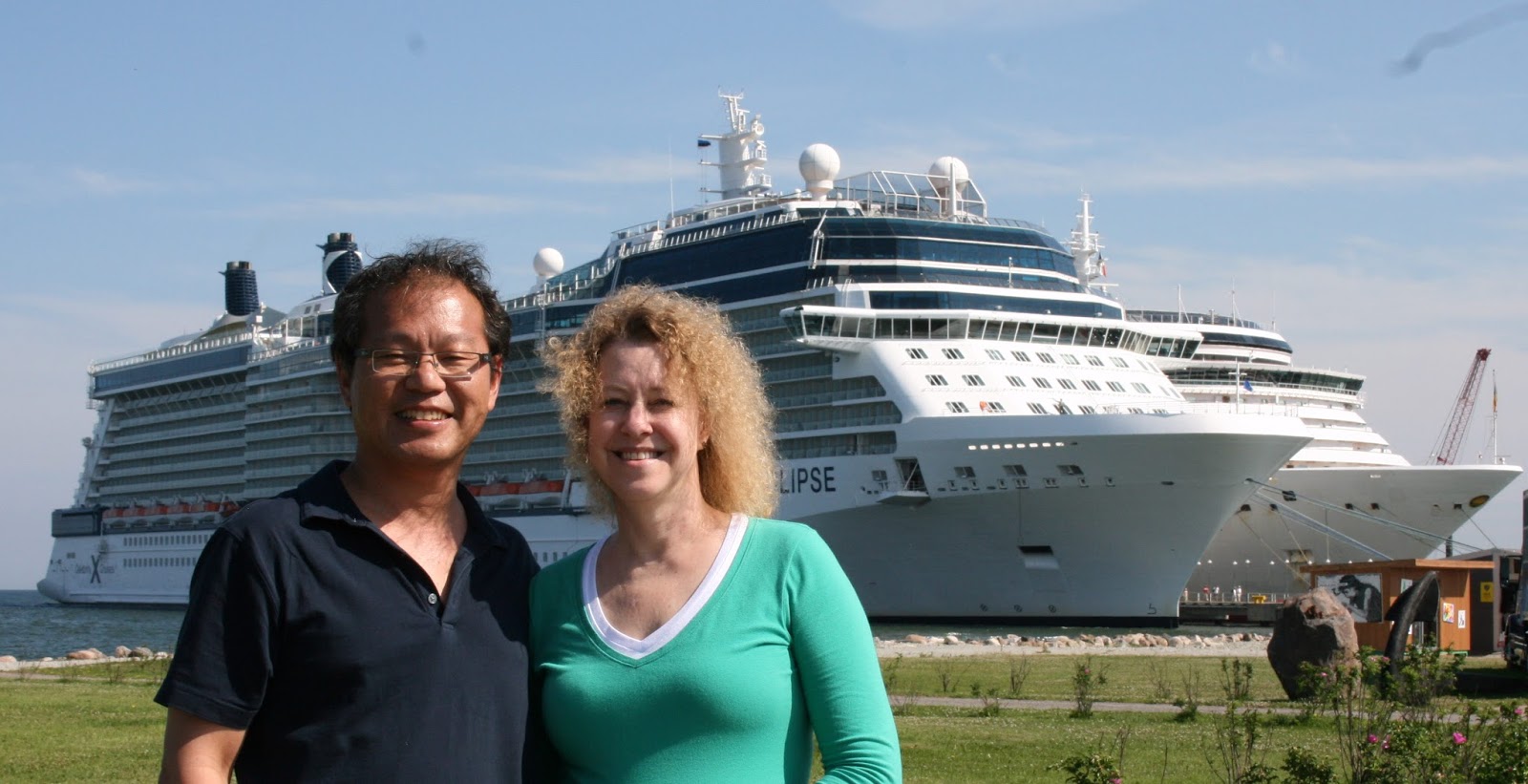
Our dinky beers paled in comparison to theirs so we slid our tiny diminutive butts close to them, took up their mugs (larger than my head) and snapped photos for fun. Since the pictures were on Wen’s smart phone, he immediately emailed them to our new giant friends.


We learned a few lessons: don’t judge a dinner neighbor, open up to even the most unusual fellow travelers, and be sure to tell others about the joy of Tallin’s honey beer, a nice finish to a beautiful day in Estonia! The best of our trip!

~ Karen Albright Lin


Tuesday, August 13, 2013

Teaching my way through the Baltic - Part 2, by Karen Albright Lin

In March, Karen Albright Lin shared the beginning of her journey on how to teach writing on a cruise. If you didn't have the opportunity to read that blog, here's the link: Writers, Want a Free Cruise? The Secret is Revealed.

Yesterday, Karen shared the first installment on the results of her first trip. Today, we're visiting the Baltic again for the second installment.

In September we'll share subsequent installments!

To refresh your memory, Karen Albright Lin consults and edits for published and yet-to-be published writers of fiction, nonfiction, and book proposals. She writes in a number of genres and conducts writing workshops in various venues. Her website is www.karenalbrightlin.com.

And now, let's all set sail, and again join Karen in the Baltic!

Janet Fogg

---------------------------------------------------

I never would have thought I’d end up cruising through the Baltic, let alone have it be free for my husband and me.  This post is part two of my report on the experience.  


We’d visited London for a few days before hopping on the ship, meandered through Belgium for the beer and Rostock in former East Germany. I’d already taught “Have a Great Story to Tell?” and “Writing Your Life” to eager cruise guests. My husband and I had taken up daily Zumba, become regulars on the ballroom and pop dance floors, and had gotten used to the norovirus-restrictive dining. It was DAY SIX, time to visit Stockholm.

We saw cathedrals that all became a blur, a palace, and the building where the Nobel Prizes are awarded. Then we lucked into a prized spot to watch the changing of the guards. 


DAY SEVEN we docked in Helsinki. We had little time to do much beyond taking photos of Senate Square, the Rock Church, cathedrals, and museums. But we found time to taste their famous rye-battered tiny fish and reindeer meat accompanied by horrendous room-temp 2% local beer. From Belgium forward we’d decided try a local beer at every stop. Exploring the nooks and crannies of new cities is more fun with a bit of a buzz. Starting our search for souvenirs, we skipped over reindeer pelts Wen had eyed, figuring hometown Boulderites would sniff it out. Every thing was very expensive when converted to Euros. And many of the smaller items were made in China.

We’d barely caught our breath when we woke too early on DAY EIGHT and DAY NINE to join a large group on our VERY EXPENSIVE 2-day excursion to Russia’s St. Petersburg.  If you arrange for a visa yourself ahead of time it is $300.  If you take a $370 excursion it is tucked inside that cost.  So double that and you can see that it was the biggest cost of our trip – since frequent flyer miles got us to and from the ship in Southampton.  It was worth every penny. 

Though our guide was painfully political, bashing Germany every other step, she knew all the hot places to go and got us great spots standing before two DaVincis in the Hermitage – the largest museum collection in the world. Then there was the remarkable Church of Spilled Blood.


One of my favorite indoor places of the whole trip was the amber room in Catherine’s otherwise gold-gaudy baroque palace.
  In honor of that amazing room, I brought back amber souvenirs.  After all, the ubiquitous nestling dolls were mostly made in China.       
Another must-see was the Peterhof with its grand fountains overlooking the Gulf of Finland.     Looking back, that excursion was eye opening. The USSR was enemy number one when I was little, one reason we learned to file down to the basement of our schools then duck-and-cover… not only for the Missouri tornados. The Cold War made me fear all things Russian.

I no longer fear it.


I’ll continue with my writer’s journey through the Baltic next month.  Stay tuned!

~ Karen Albright Lin


Monday, August 12, 2013

Teaching my way through the Baltic, by Karen Albright Lin

In March, Karen Albright Lin shared the beginning of her journey on how to teach writing on a cruise. If you didn't have the opportunity to read that blog, here's the link: Writers, Want a Free Cruise? The Secret is Revealed.

Below you'll find Karen's first installment on the results of her first trip. Join us tomorrow for Part Two, with subsequent installments in September!

To refresh your memory, Karen Albright Lin consults and edits for published and yet-to-be published writers of fiction, nonfiction, and book proposals. She writes in a number of genres and conducts writing workshops in various venues. Her website is www.karenalbrightlin.com.

And now, let's all set sail, and join Karen in the Baltic!

Janet Fogg

---------------------------------------------------

In June I had the pleasure of teaching on a cruise through the Baltic. I’m back and would love to tell you about the experience: the good, the bad and the wonderful. 


My husband, Wen, and I adjusted to the mid-June BST time zone by staying in London for a few days before taking a bus to Southampton then a taxi to the port. My special boarding letter allowed us into the VIP short line but before we could get into it, we discovered that the port personnel had no idea how to mark our bags. As a guest speaker, my state room wasn’t on the manifest. We were asked to leave them abandoned, isolated from the others. We could only hope they’d make their way onto the ship.

Once aboard, it took a trip to the guest relations desk to find out that our mystery room was just past the “crew only” door. When the bags didn’t arrive, we went searching. We soon found one of them outside another state room door and grabbed it. After informing someone who appeared to be a bag delivery man, we later got the other two.

The first meal was a bit chaotic, as they implemented new server rules after the last trip included a norovirus outbreak. That also explained the obsessive sanitizer guy at the dining room door.

I donned my spiffy blazer and met the activities director and the cruise director to film a teaser for the classes. It would air on the stateroom TVs. We filmed in what would become Wen’s and my afternoon Zumba/karaoke/pop dancing hangout the rest of the trip. In one quick take I gave a brief bio and a general idea of what I would teach. I never turned the in-house TV station on to see it or the subsequent 5 classes I taught.

We spent DAY TWO wandering and sampling terrific beers in Zeebrugge, Belgium.


When the next day’s itinerary was delivered, I discovered that my classes were scheduled parallel to a quiz game modeled on a popular British TV show as well as talks about coming ports. The competition was akin to teaching at a writers’ conference parallel to Donald Maass, Deb Dixon and Robert Crais.

After the luggage SNAFU and the clogged up dining hall, I worried about whether there would be an AV assistant helping me get hooked up to the screen when I was to teach the next day.

DAY THREE, Sea Day, 10:15am, first class: Have a Great Story to Tell? I was relieved that the AV guy was there and a perfect helper. I used a headset like Justin Bieber’s and felt like a star in front of the red velvet curtain, a screen the size of a three-car garage door, and one smaller one off to each side. There were 30 or so in the small theater and I discovered quickly that Brits and Australians (and a scattering of Irish and Scotts) were extremely attentive but did not like to raise their hands when queried. I had to adjust; I was used to U.S. writer attendees who tend to be wide-eyed and eager to contribute. I was thrilled when several followed me out, complimenting my PowerPoint presentation, sharing their stories and asking questions. The number of attendees who chatted with me after the sessions grew over the course of two weeks.

My husband and I are both gregarious. We chose the flexible dinner time and to be seated with new people each night. Along with dancing and socializing every chance we got, this was a great way to get to know many guests and talk up my classes—one reason the attendance grew. A new friendship sometimes overrides a quiz game!

The evening after my first class, we returned to our room to find a “job well done” iced-down bottle of Champaign and a plate of apples. Of course, I called the activities director to thank her.


DAY FOUR we strolled through former East Germany’s Warnemünde and took a train into the quaint town of Rostock to visit the Marienkirche Church and see the world’s oldest working astronomical clock (built in 1492).


DAY FIVE, at sea, I taught Writing Your Life to a bit larger crowd. Lots of fun energy and a few people willing to raise hands and ask questions. Balcony vantage at that evening’s Las Vegas-style show offered a view of a sea of gray and silver hair, many likely interested in puttinig legacies to paper.


If my class motivated a few of those in the crowd to write their stories, I will have earned my free cruise for two.

~ Karen Albright Lin


Monday, November 12, 2012

Elements of Successful Novels: The First Two Pages

This post from Julie Kaewert was written for the Sisters of the Quill blog, and my sisters, including Julie of course, have kindly given me permission to share it here. Janet Fogg

I've just returned from two glorious weeks at the University of Iowa Writing Festival in Iowa City. It's always a little like drinking through a fire hose; as usual a great deal of useful information on writing was exchanged. I have a fun and useful tip to share.

We all know the first few pages are crucial to keep the agent or editor reading, so I signed up for the week-long course, "Beginning the Novel." The tone of the workshops tends to be literary rather than commercial, so our wonderful workshop professor, Gordon Mennenga of Coe College, apologized for coming dangerously close to being formulaic before sharing this. He'd gone into a bookstore, the classic Prairie Lights (Iowa City's Tattered Cover), and picked up all of the bestselling and otherwise successful novels of the past year or two. Each of them had all of the following on the first two pages (brace yourself!):

a sentence containing three commas
a one-word sentence
alliteration
food (the universal ritual)
body fluid--sweat, blood, tears, urine
reference to sex or death
something sinful or painful
a color
a physical feature
a personality trait
question mark
mention of nature
anything with a brand name
furniture
body part or parts
smell/odor
metaphor, each of which saves five pages of description
city, state or street
walk/gesture/overbite/musculature

He had us go through our first two pages and check off how many of these we had included. Most of us had two or three; one of us had ten or so (way to go Alan!). As far as evoking sensations in the reader, we realized we were writing at about 1/10 power. You might enjoy going through your first two pages and seeing how many you instinctively included...and then add the rest! You can always take them out again if it feels too much, or too contrived, but it's a useful exercise in writing vividly with all the senses.

Happy writing.
SP


Monday, July 16, 2012

Reflections on Time Spent Writing


I’ve spent thousands of hours writing, perhaps even tens of thousands of hours, and the very magnitude of that number made me pause to consider how I might otherwise have spent that time. My house might be less dusty, though I should emphasize “might” since I dislike housecleaning and avoid it as much as is possible. I would definitely have read more books, many, many more books, and my garden would be much larger. What else? Ah yes, I would have attended more classes.

Despite working full-time I used to study all sorts of things: I learned how to ride a motorcycle, throw and fire clay pottery, public speaking, knitting, rock-climbing, and mountaineering. I climbed two dozen Fourteeners, some dangerous, some not. In the midst of all of that I also decided to write a novel, high-fantasy no less. I completed that first draft oh so many years ago, and back to Lifelong Learning I went to learn how to get published.

How to get published? Now there’s a challenge! Semi-annual writers conferences soon usurped Lifelong Learning classes and critique meetings adorned my calendar. Writing, writing, writing and new, cherished friends. So the years passed.

Would I have met my sisters and brothers of the quill without penning that first manuscript and attending that class? The odds are poor and quite sad to contemplate. What about those books with my name on the spine? They would not exist. Also sad to contemplate.

All those hours of anguish and hope, of deliberation and delight.  All those words. All those worlds. Time well spent, don’t you think?

by Janet Fogg
Janet Fogg is the author of Soliloquy, an award-winning historical romance, and co-author of the military history bestseller, Fogg in the Cockpit.

A previous version of Reflections on Time Spent Writing first appeared on the Sisters of the Quill blog.

Monday, June 18, 2012

If I have to cry to write this next book, somebody is going to be in trouble.

Ever have the feeling the universe is trying to stuff something into your big, fat, ugly head? Maybe it’s not so much a “woo-woo” experience as it is your inner mind focusing on something before it tells your everyday mind about it. Sort of like I kept seeing pregnant women right before I decided I wanted to have a baby. (And what was I thinking then?) I don’t like subliminal messages from myself. I rely on my normal shallow nature to protect me from deep emotion.

Last October, Cricket McRea, author of the Home Crafting Mystery series, posted a blog about Splat.  This is a technique for discovering the inner workings of your own mind so you can plumb the depths of your fear and anxiety to create more complex and interesting characters.

Now doesn’t that sound like fun?

At the 2011 Rocky Mountain Fiction Writer’s Colorado Gold Conference, I attended a three-hour workshop given by romantic suspense writer and amazing writing coach, Laura Baker, of Story Magic fame. The workshop was entitled The Fearless Writer: Discovering Your Story. Among the eye-opening and light bulb-illuminating tidbits in this workshop, Laura walked us through a bit of psychoanalysis all in the name of finding a good story. Talk about stepping out of my six inch deep comfort zone.

At the most basic, The Fearless Writer course is about discovering what made you begin writing. Before you learned you couldn’t write because you didn’t know about stimulus and response and point of view and voice and character arcs and turning points, what gave you the passion to tell the story inside of you?

Before we can answer this question, we have to go through a series of exercises, dredging up all the good, bad and ugly we’ve squirreled away throughout our lives and find out what our purpose is in storytelling. Like cats, some of us are particularly good and burying our, ahem, “unpleasantness.” And like Methuselah, some of us have enough years on our bones to have accumulated a lot of said “unpleasantness.”

Laura had us look at stories and characters we found easiest to write and those we couldn’t complete. Using our own life experiences, we drew links to our stories and can then discover what our strengths are as writers. The exercises took the pain and joy in our past and associated that emotional gunk (that’s my technical term) with our stories to find themes we return to.

I’m not about to tell you all the personal dysfunction I discovered in just three hours of this workshop. It’s embarrassing how much of my therapy has been worked out in the pages of my books. But it makes for some particularly flawed characters with lots of growth potential. Obviously, Laura’s workshop is way more involved than what I’ve plastered here and I urge you to check it out on her Fearless Writer site.

When I fearlessly and foolishly decided I wanted to be a writer, no one told me I was going to have to pull out all the nasty little bugs hiding in the dark recesses of my brain. Like spiders in my house, I’m way happier if I don’t see them. I’m not all that into self awareness, we shallow people shy away from that. I have honed the art of denial until I’m a true master. And now the dagnabbed universe is banging me on the head with a sledgehammer and telling me to dig deeper. Fine, okay, I’m not stupid, I get the message. But if I have to cry to write this next book, somebody is going to be in trouble.

What about you? Do you enjoy the process of baring your soul, even in disguise, in your work?

By Shannon Baker

Shannon Baker's first thriller, Ashes of the Red Heifer, is available in trade paperback and ebook at your favorite online bookseller. The first book in her Nora Abbott mystery series, Tainted Mountain, will be available in early 2013 from Midnight Ink.

Originally posted 10/7/11 on the Sisters of the Quill blog

Monday, June 4, 2012

Make it an Effortless Read

Last year I returned from the Colorado Gold Conference with a head full of inspiration and a heart filled with gratitude for our amazing Colorado writing community.

One of several workshops I attended stood out because it addressed head-on a difficulty I’ve been having with the beginning of my book. Sara Megibow (from the Nelson Literary Agency) taught a workshop entitled: Bang! Zoom! Pow! Those First 30 Pages and Why They are so Important and How to Make Them POP.

I’ve been to many similarly titled workshops and have found most impart the same information. But I figured it couldn’t hurt to have it all reinforced again -- especially in light of the feedback I’ve been receiving about my book, Mu Shu Mac-N-Cheese. It works extremely well except the very beginning.

My query letter is effective; I’m usually asked to send full manuscripts. My voice, I’m told, is courageous and works well with the characters and storyline. I’ve even been told by agents that it is a marketable, commercial novel. So what about the beginning is holding it back from earning representation in this tough market?

I have a lot in my first chapter, clearly too much. Mario Puzo got away with it, and one agent suggested I study the beginning of The Godfather. Puzo detailed the back-story of the various characters who sought the aid of the powerful Godfather. The lesson seemed to be that I needed to give the reader more to latch onto about the motivation of the few characters I introduce in the beginning of the book. I was also advised that my voice was so strong that it “overwhelmed the narrative.” That was more difficult to decipher. My critique groups helped me interpret this. I have a rather unusual way with language sometimes. Maybe it is the poet in me. Maybe it is my twisted sense of metaphor. Maybe I try too hard to have an atypical approach to word play. I think it is all of the above.

Back to Sara’s helpful advice. She explained four things that automatically earn rejections from their agency.
1) Data dump
2) Work not written with genre requirements
3) Awkward dialogue
4) Weak character or voice

Great advice. But none of these seemed to address the dissatisfaction over MY beginning. I’d pretty much pounded out the above common problems working over the years with my critique partners and taking a long detour writing screenplays.

Then Sara talked about what makes a beginning POP. First:

INCITING INCIDENT

She emphasized that the inciting incident shouldn’t be in a prologue, and, in fact, “mainstream fiction shouldn’t even have a prologue.” My book is mainstream women’s fiction and the story takes place twenty years after my Midwest-raised protagonist marries into a traditional and dominating Chinese family. In the PROLOGUE, my protagonist meets her future husband on the dance floor, beginning the dance of their marriage. It’s only one page long. One page. One page! ONE page!!! It sets up the marriage! Right?

It seems I’ve started my book with one of those gnarly, dreaded darlings. And that I should work the information in, as needed, later in the book. Ironically, I taught a workshop at the conference about back-story in its various forms and specifically about writing flashbacks. I warned against flashbacks that come too early. Guess I’ll have to review my own notes.

Chop off my prologue, and luckily I still have a strong inciting incident. That is not the problem. Sara’s last observation about beginnings that POP was less straightforward than items of craft and as elusive as voice.

AN EFFORTLESS READ

We’ve all experienced it. We open a book and force our way through the first few pages, slogging along, debating whether or not to take more of our precious time to unravel a tangle of too many ideas, dense prose, flowery overkill, or a mess of complicated sentences. Hers was not a surprising suggestion. But somehow, the way she stated it became an “AHA!” moment for me. I and my critique partners know my book so well that we didn’t recognize the introduction of too many conflicts, each on the heel of the other, and the story promise with too many angles. The morass of too-tight writing.

I cared too much about getting it right, about dragging the reader in with so many questions to be answered, and not one spare word. I’ve over edited the beginning of Mu Shu Mac-N-Cheese to the point of it being dense compared to the rest of the book that manages to breathe. It wouldn’t be too far off to call the beginning constipated while the rest is…well… smooth moving.

I now have a plan of attack. Not an easy plan, especially for this freelance editor who usually deals with tightening chubby prose. But what in a writing career is easy? I am going to make my entire book breathe.

Make it an effortless read.

Thank you, Sara.

By Karen Albright Lin

Karen is an editor, ghostwriter, pitch coach, speaker and award-winning author of novels, cookbooks, and screenplays. She’s written over a dozen solo and collaborative scripts (with Janet Fogg, Christian Lyons and director Erich Toll); each has garnered international, national and regional recognition.  Find out more at Karen's website.

Originally posted on Sisters of the Quill, a blog shared by Karen Albright Lin, Janet Fogg, Julie Kaewert and Shannon Baker.

Monday, November 14, 2011

Elements of successful novels: the first two pages

This post from Julie Kaewert was written for the Sisters of the Quill blog, and my sisters, including Julie of course, have kindly given me permission to share it here. Janet Fogg

I've just returned from two glorious weeks at the University of Iowa Writing Festival in Iowa City. It's always a little like drinking through a fire hose; as usual a great deal of useful information on writing was exchanged. I have a fun and useful tip to share.

We all know the first few pages are crucial to keep the agent or editor reading, so I signed up for the week-long course, "Beginning the Novel." The tone of the workshops tends to be literary rather than commercial, so our wonderful workshop professor, Gordon Mennenga of Coe College, apologized for coming dangerously close to being formulaic before sharing this. He'd gone into a bookstore, the classic Prairie Lights (Iowa City's Tattered Cover), and picked up all of the bestselling and otherwise successful novels of the past year or two. Each of them had all of the following on the first two pages (brace yourself!):

a sentence containing three commas
a one-word sentence
alliteration
food (the universal ritual)
body fluid--sweat, blood, tears, urine
reference to sex or death
something sinful or painful
a color
a physical feature
a personality trait
question mark
mention of nature
anything with a brand name
furniture
body part or parts
smell/odor
metaphor, each of which saves five pages of description
city, state or street
walk/gesture/overbite/musculature

He had us go through our first two pages and check off how many of these we had included. Most of us had two or three; one of us had ten or so (way to go Alan!). As far as evoking sensations in the reader, we realized we were writing at about 1/10 power. You might enjoy going through your first two pages and seeing how many you instinctively included...and then add the rest! You can always take them out again if it feels too much, or too contrived, but it's a useful exercise in writing vividly with all the senses.

Happy writing.
SP

Monday, June 6, 2011

“I still don’t want to think my words will live forever—”

By Janet Fogg and Shannon Baker

Two of my friends learned earlier this year that long-forgotten projects, in one case a magazine article and the other a short-story, were unexpectedly scheduled for publication. I asked both to share their thoughts about these primal submittals, and while we hope to celebrate publication of the short-story in the near future, today it’s my pleasure to share Shannon Baker’s story about a magazine article that unexpectedly found new life.

From Shannon:


“Recently I received an odd looking envelope in my mailbox. One glance at the handwritten address made it even odder since it was from my ex-husband. Though I doubted it was a death threat, we aren’t exactly pen pals.

“Inside I found an opened envelope from Range Magazine. In my previous life, my husband and I owned a feed store in rural Nebraska, a business he still owns. Without paying too much attention, he’d opened the envelope, supposing it was a business matter. Inside was a check and a letter addressed to Shannon Dyer, a name I’d used for nearly half my life. What the letter said was that an article I’d published some fifteen years ago had been selected for an anthology, “Best of The Red Meat Survivors,” to be released later that month. (Yes, it was nice of my ex to send it. But that’s another story for another day.)

“What a shock. As in those old movies where the calendar pages fly off the spindle, I was whisked back fifteen years to a summer I’d spent driving 94-year old Albert around the Nebraska Sandhills he’d loved so much. His family wanted me to capture his stories and we discovered his best prompts were seeing his old haunts. I ended up publishing about a dozen of his stories in a series for a regional weekly paper and sent this profile off the Range.

“I’m not a great strategic thinker. I’m sort of a short term planner. Get in, get out, stay light on my feet. I never really think that the words I send out into the world might have staying power. For me, they are like potato chips. You crunch them down, enjoy the salty goodness and move on. They aren’t particularly memorable or full of nutritional value.

“So much of what I write--maybe it’s this way for all writers—is from the here and now. What I’m feeling and how that colors my world today. My frame of mind while I was in Nebraska was not always rosy. I was scared to death what that article would sound like tempered through the lens of time.

“When the book arrived I was full of trepidation. I located my story with a pounding heart. I opened it and read…about Albert. The story wasn’t about my words. I didn’t recognize them. Perhaps a kind editor had cleaned them up. What that story did, however, was bring that fine man back to life for me. I could hear his low, slow voice, see the ‘hills though his eyes again.

“It’s always a bit of a jolt when I discover everything is not about me. In this case, it was a rewarding surprise. I still don’t want to think my words will live forever—that’s too much pressure. But if something I wrote is going to last, I am honored they give memory and life to the kind and gentle soul of Albert Hebbert.”

Shannon Baker is the author of Ashes of the Red Heifer, has contributed to numerous anthologies, magazines, and newspapers, and has a new thriller scheduled for publication in 2012 by Midnight Ink. Set in Flagstaff, AZ, where Shannon works for the Grand Canyon Trust, her new book involves man-made snow on sacred peaks, uranium mining in the Grand Canyon, kachinas, murder, and a woman determined to make some sense of it all.

You can find Shannon at the Sisters of the Quill blog or at her website.

Monday, March 28, 2011

Crazy Eights - The Query Game!

by Janet Fogg

Remember the card game Crazy Eights, where the object of the game is to be the first to get rid of all of your cards?

So how many queries do you have out? Right now! Today! At least eight, I hope. Why? No, it’s not because I think sending out query after query implies any hint of mental instability. Well, maybe a little, but I’m just as crazy. The real reason is because the number eight is a most auspicious number, and as writers we can use all the luck we can find.

A few years ago my good friend and Sister of the Quill, Karen Albright Lin, began a new manuscript in which several of her characters regularly seek out the number eight in their everyday lives. Travel on the eighth day of the eighth month is particularly lucky; they own eight copies of a book, eight nail-clippers, and so on. Karen explained to our critique group that Asian cultures go out of their way for the number eight. Phone numbers and addresses that include the number eight are sought after and often purchased. Eight is the lucky number and means you will prosper.

The Sisters of the Quill then casually adopted the number eight. We nudged one another to send out queries in batches of eight, which ultimately evolved into keeping eight queries out at all times, until a manuscript is accepted. Receive a rejection? Get another query out! No excuses, though ten minutes of angst is allowed. Keep it at eight queries because that’s luckier than six or seven. Last summer I even found myself pulling weeds to the count of eight, though in retrospect it occurs to me that the weeds weren’t particularly lucky. Alas, poor weeds, I knew them well.

Am I really that superstitious? Are my Sisters of the Quill? I don’t think so. But I do believe that writers need a modicum of luck, a great deal of perseverance, and a granite-like streak of stubbornness. Yes, our writing has to sing with our own unique voices, but if we don’t query we’ll never get published, and rejection can beat you down. So you have to be stubborn. You have to persevere. Plus you have to find the right agent or editor at the right moment. That’s where the luck comes in. But if you’re not stubborn enough to keep at it, you’ll never get lucky! They’re truly symbiotic. Crazy, isn’t it?

In the card game Crazy Eights, each player receives eight cards. Players discard their cards by matching either the rank or suit of the top card on the remaining stack of cards. If you can’t match a card you draw another. First player to discard all of her cards wins. Sound familiar? Our manuscripts have to match what an agent or editor seeks. That means we have to keep playing the game by researching exactly what they want, and then throw down our card by getting that query out the door. Why not seek out luck as well? Why not keep eight queries in circulation until you win? Yes, it’s a bit of a game, but if you don’t throw down, well, you know what happens then.

Who wants to shuffle?

(This time next week? Join me for: Snow Write and the Seven Thwarts!)

Monday, March 7, 2011

The Magical Fellowship of Writers

This post from Julie Kaewert was first published on the Sisters of the Quill blog, and my sisters, including Julie of course, have kindly given me permission to reprint it here.

I suspect and hope that all writers have at some point experienced such a magical fellowship, but in the lonely months between conferences, or if you're unable to enjoy regular critique meetings, perhaps this will remind you of those moments and your spirit will be refreshed. Janet Fogg


The Sisters of the Quill share the magical fellowship of writers. We’ve been knit together by more than a decade of shared writing and experience and friendship into a tight and beautiful weave. A special atmosphere descends on our group, wherever and whenever we meet, a sacred trust. When we’re together and writing, or even talking about writing, all things seem possible. A writing fellowship feels a little like walking into church: the moment you enter, you see only the purest and best intentions of your fellows. Together you are free, emboldened and strengthened to strive wholeheartedly toward the goal.

This miracle repeats itself to some degree at every writing conference, be it Rocky Mountain Fiction Writers or Pikes Peak. It’s wondrously present in every workshop at the Iowa Summer Writing Festival. One summer my mother, daughters and I had the unbeatable experience of feeling it together. Miraculously, it eliminated our generational differences and reduced us to a common denominator: we were writers.

Once I had a remarkable experience with complete strangers that seems to confirm we writers share a certain understanding. It was an Algonkian Pitch Conference at a place called the Roundhouse in Western Massachusetts. Three stories high, this teepee-shaped log building had “niches” instead of beds; we crawled into them like squirrels into treeholes. Isolated together in remotest countryside, sock- or slipper-footed by house rules with the owner’s new puppies frolicking at our feet, we had entered a magical kingdom. It even snowed.

On a surface level, we completed writing assignments and honed our novel pitches to present them to top agents on the last day. But it was like a sauce at a great French restaurant: magically more than the sum of its parts. I’ll never be sure what added the crackle of energy to the air. No doubt many elements contributed, including the setting and our shared intense motivation. Some of it was brilliant organizer Michael Neff’s expertise in teaching and facilitating, and his own extraordinary passion for helping us get our novels published. The poetry group sharing the facility also added to the feeling of intense creative stimulation. But over the course of two or three days our disparate group of a dozen or so novelists—doctors, secretaries, stay-at-home moms, executives, full-time intellectuals, and a retired military officer—became connected spirit to spirit.

Miraculously, we could only see the best in one another. We genuinely cared as much for one another’s novels as for ourselves. It seemed we all felt the magic and understood this was a moment set apart in time. Though we would compete for the agents’ nod on the last day, there was not the least hint of competitiveness. If most of us had completed our writing exercises and honed our pitch for the day, but one writer was still struggling at midnight, we all stayed up to brainstorm. (I think the poets were up all night, every night.) We felt a strange sort of high, though no substances were involved. It was the pure joy of being constantly inundated in one another’s most focused creativity, the best we had to give. There was no attitude separating literary and commercial writers; we were writers, and that was all.

Writers, I cherish our mysterious and precious fellowship.

Storm Petrel